Mickey Paulssen — Art, Aquascaping and Nature Underwater
Mickey Paulssen is an artist and aquascaper whose work moves quietly between drawing, painting, portraiture, koi, and underwater garden design. Her art is rooted in observation. She looks carefully at form, light, movement and character, whether she is drawing a portrait, studying a koi, or creating a planted aquarium.
On Miroshaki, Mickey’s work has a special place. Her aquascapes, drawings and natural style helped shape the atmosphere of this renewed community. Her way of working is calm, patient and close to nature. It invites people to look more slowly and to notice the beauty in small details.
A Quiet Foundation in Art

Titus van Rijn — mixed media, 13 x 18 cm
Mickey studied at the Academy for Visual Arts in Genk, where she worked with drawing, painting, etching, nude studies and realism. Art history formed an important part of that education. It gave her a strong base, but her own work has always stayed close to feeling and observation.
Realism is an important part of Mickey’s artistic language. She pays attention to shape, shadow and expression. At the same time, she does not treat realism as something cold or technical. In her hands, realism becomes gentle. It becomes a way of seeing the life inside a subject.
Sometimes Mickey also moves beyond the flat surface. Her mixed media work, such as Titus, shows how she can bring texture, memory and presence into a small artwork. It is not only about copying what is visible. It is about giving the image its own quiet depth.
Portraits with Care and Attention
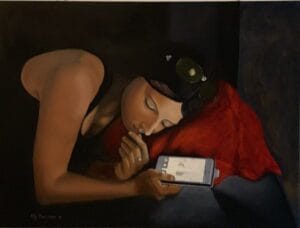
Mickey Paulssen’s portraits are made with patience. She looks for more than likeness alone. A good portrait needs softness, structure and trust. It needs the small details that make a face or animal feel present: the direction of the eyes, the weight of a shadow, the shape of the mouth, or the calm in a resting pose.
Resting Robin
She works with different materials, including pencil, pastel and paint. Each material asks for another rhythm. Pencil can be precise and intimate. Pastel can be soft and atmospheric. Paint can carry more weight and colour. Mickey uses these differences naturally, depending on what the subject needs.
Her portrait work can be explored further in the Mickey Paulssen Gallery on Mantifang, where people, animals and personal studies come together in one visual world.

Liva
What connects these portraits is not only technique. It is attention. Mickey’s work often feels as if the subject has been watched with kindness before being drawn. That same way of looking later became important in her aquascaping.
Koi, Lines and Living Movement

Shiro Bekko
Nishikigoi, or Japanese koi, became another important subject for Mickey. A koi is not still in the same way as a portrait. It moves through water. Its body bends, turns and reflects light. Its pattern changes with every movement. Drawing koi asks for a different kind of observation.
Mickey’s koi drawings often focus on line, balance and the living shape of the fish. She studies the way a koi carries itself in the water, how the fins open, how the body curves, and how white, red, black or yellow markings create rhythm across the form.
This part of her work connects naturally with the world of koi on Mantifang and with Mickey’s koi drawings on KoiTalk.
Observation is the most important lesson I have learned.
That sentence says much about Mickey’s work. Whether she draws a koi, a bird, a face or an underwater garden, she begins by watching. Not quickly, but carefully. This makes her art feel close to nature, even when it is made with pencil, pastel or mixed media.
Aquascaping as Nature Underwater
The Path
Aquascaping gave Mickey a new kind of space. Instead of working only on paper or canvas, she began to create small landscapes under water. Plants, wood, stones, moss and light became her materials. The aquarium became a living composition.
Her aquascaping is inspired by natural balance and by the work of Takashi Amano. Mickey met Amano in Hannover in 2012, a moment that strengthened her connection with Nature Aquarium design. His work showed how an aquarium could become more than a tank. It could become a quiet world.
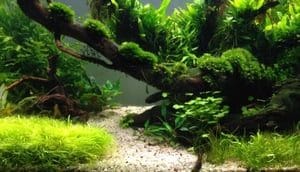
Mickey’s underwater gardens are not loud or forced. They are built around patience. Plants need time. Moss needs time. A path inside an aquascape slowly becomes visible through growth, trimming and care. This is also the spirit of Miroshaki: learning by watching nature underwater.
More of Mickey’s aquascaping and art can be found through her Mantifang page.
A Natural Link Between Art and Aquascaping
Mickey’s work does not separate art from aquascaping. A portrait, a koi drawing and a planted aquarium may seem very different, but they all ask for the same quiet attention. They all depend on balance, composition and feeling.
In her portraits, she looks for character. In her koi drawings, she follows movement. In her aquascapes, she creates a small natural world where plants, water and light can grow together. This makes her work especially important for Miroshaki. It shows that aquascaping can be practical and artistic at the same time.
Mickey’s broader fine art can also be explored on Mantifang Fine Art.
Mickey Paulssen Online
Mickey’s work and related projects can also be followed through her online pages and communities.
Welcome to Mickey’s World on Miroshaki
Mickey Paulssen’s work reminds us that aquascaping begins with looking. A planted aquarium is not only equipment, water and plants. It is also patience, balance and imagination.
On Miroshaki, her art and aquascaping help set the tone: friendly, natural, calm and open to everyone who wants to learn.